Sunday, July 10, 2022

The Fed : No Complaints

The one guy Roger has never beaten. He's beaten Rafa on various surfaces, but he never figured out Novak. Sure, it doesn't help being five years older. But, the other two are kicking guys 20 years younger without complaining.

I maintain, both R and N will end up with 26 each. 

Congratulations Novak Djokovic. I give Rafa a higher rating for mental toughness, but you're still the man, the GOAT.

BTW, last time I saw a guy's first serve being slower than his opponent's 2nd serve? Sampras v Rafter - which Sampras won relatively easily I think - though Pat got Set 1.

Saturday, July 09, 2022

On Making a Homemade Gun

Tetsuya Yamagami with his self-defense widget

At Yamagami's place, they found "zip" and "pipe" guns. Two metal barrels and a wooden board with a firing mechanism. BTW, you know who really knows guns - as in how to get good value for your money? Ans : the Royal Thai Police. They are not issued weapons and have to spend their own personal funds to acquire firearms (source : Operation Relentless by Damien Lewis)

Mitsuru Fukuda (Prof. in College of Risk Mgmt, Nihon Univ) : "The making of guns with a 3D printer and the manufacturing of bombs can nowadays be learned off the internet from anywhere in the world"

Prof. Mitsuru Fukuda circa 2010

Suspect (Yamagami) stated that he had search online for instructions and ordered parts and gunpowder off the internet. Really? What if you don't want to leave a paper trail? The gun measured 40 by 20 centimetres (15.7 by 7.9 inches), and was made of materials such as metal and wood. Electrical wire passing from the cap on the end of each pipe implied an electrical firing mechanism says N.R. Jenzen-Jones - Armament Research Services analyst. 

N.R. Jenzen Jones - kickass gun commentator


Extreme :


Mushroom: The story of the A-bomb kid Hardcover – January 1, 1978

John Aristotle Phillips serves as CEO of Aristotle, where he has earned a reputation as an innovator, entrepreneur and valued advisor in the field of politics.

Mr. Phillips is a pioneer in the strategic applications of technology to politics and political communication. He has addressed the membership of the International Association of Political Consultants, the European Association of Political Consultants and the American Association of Political Consultants.

Mr. Phillips graduated from Princeton University in 1978 with a Bachelor of Science in Aerospace Engineering. While at Princeton, Mr. Phillips received international recognition for his design, made from publicly available documents, of an atomic bomb. He is the co-author of Mushroom: the Story of the A-Bomb Kid.

More Mundane :


From the book made with taxpayer money :

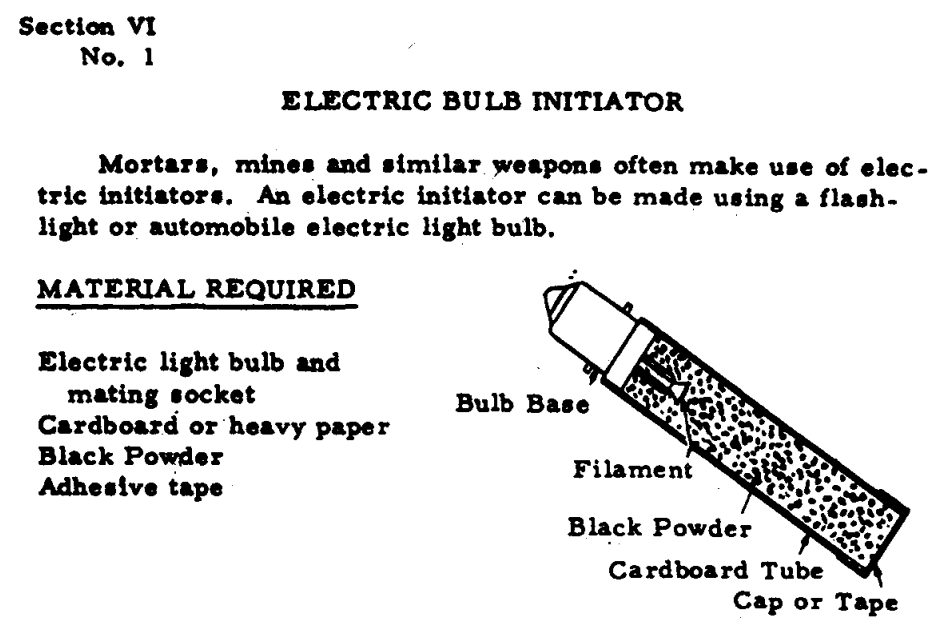
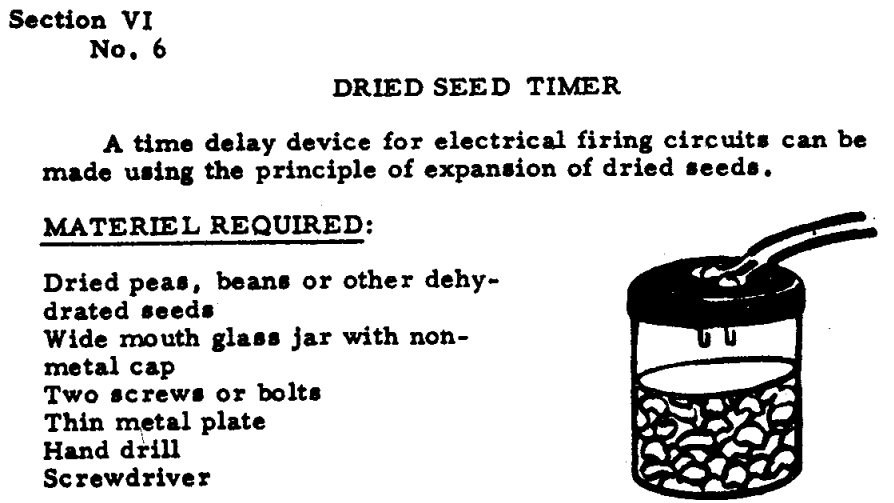
In Unconventional Warfare operations it may be impossible or unwise to use conventional military munitions as tools in the conduct of certain missions. It may be necessary instead to fabricate the required munitions from locally available or unassuming materials. The purpose of this Manual is to increase the potential of Special Forces and guerrilla troops by describing in detail the manufacture of munitions from seemingly innocuous locally available materials.

Manufactured, precision devices almost always will be more effective, more reliable, and easier to use than improvised ones, but shelf items will just not be available for certain operations for security or logistical reasons. Therefore the operator will have to rely on materials he can buy in a drug or paint store, find in a junk pile, or scrounge from military stocks. Also, many of the ingredients and materials used in fabricating homemade items are so commonplace or innocuous they can be carried without arousing suspicion. The completed item itself often is more easily concealed or camouflaged. In addition, the field expedient item can be tailored for the intended target, thereby providing an advantage over the standard item in flexibility and versatility.

"This cone charge will penetrate 3 to 4 inches of armor. Placed on an engine or engine compartment, it will disable a tank or other vehicle."


What is the firing mechanism based on? A nail and and elastic band.

Based on this, who do we need to keep an eye on? Drug, hardware and paint stores. Farm and feed stores. Remember, the first World Trade Center terrorist attach of 1992 used a fertilizer bomb.


Here's one from Gallipolli for sure :


BTW, who has an extensive instruction manual for the use of explosives? The National Parks Service. Makes sense don't it? How many times have you driven through  mountainous area and wondered what it took to make that road?

The Hoss USMC explains what a "lower receiver" is for us mere mortals :


"It was invented by Eugene Stoner" of Armalite (AR-15). Here's some vintage : Mikhail Kalashnikov who went through 46 iterations and Stoner discussing the AR-15.

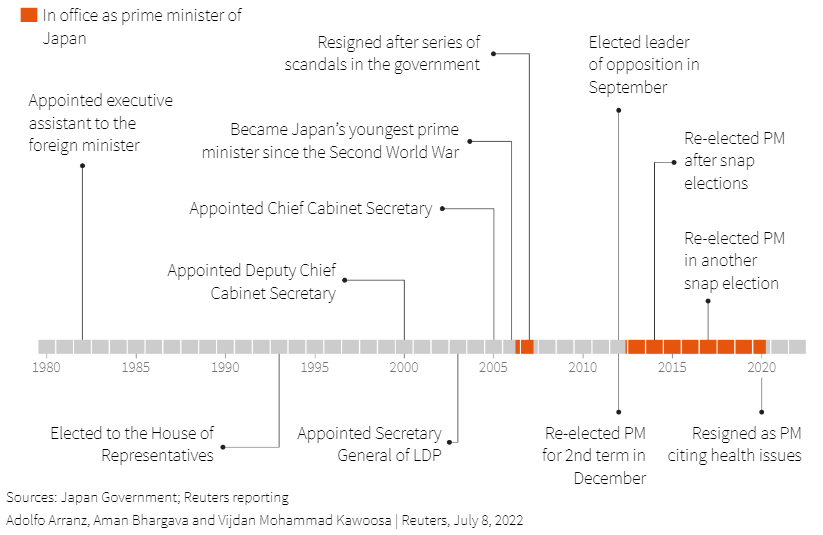
How Shinzo Abe rolled (Kudos : Adolfo Aranz, Aman Bhargava and Vijdan Mohd. Kwoosa) :

Timeline of Shinzo Abe's Political Life

As for bombs, don't expect to get anywhere without a decent detonator:

Ser. No.

Type

Description

1

Electric match / squib

A small resistive wire coated in a pyrotechnic compound. When current flows. the wire heats up, igniting the compound — very common in blasting and military applications.

2

Exploding bridge wire (EBW)

A very thin wire vaporizes instantly when subjected to a very high-current pulse (often from a capacitor bank) — used in nuclear weapons and precise applications.

3

Slapper detonator

A refinement of EBW: a thin plastic disc is ”slapped" into the explosive by vaporizing a foil bridge, giving extremely fast. symmetric initiation —again, used in high-precision military work.

4

Hot wire igniter

Similar to electric matches but slower: a nichrome wire heats up to ignite a secondary charge. Used in model rockets and low-cost setups.


Sunday, June 19, 2022

The Podcast Trove

While we're at it, why not call out all useful podcasts in one post, um?

Inside the Minds of White Collar Criminals - WSJ Audio - WSJ Podcasts : Eugene Soltes of HBS (Bernie Madoff and Dennis Kozlowski)

.. more to come..

The Unix Treasure Trove - Tips to Boost Productivity

Finally, instead of having stuff scattered all over, let's put them in one single post.

How can you get the man page you just displayed to persist after you're done (as in, you do $ man command and, after you press q, the screen has only "man command" left.) What if you want to see what were seeing a moment ago to be able to use it in the next command?

Ans : man command | less -X

More to follow as the cleanup continues.

Who are the unix tips superstars : Julia Evans needs a mention for sure. One of the densest (in a good way - meaning there's a lot of useful stuff for the real-estate consumed - unlike the TSTS blog 😊) (shellcheck - a linter, The difference between VARIABLE=2 and VARIABLE= 2 (with a space, in the second case, you assign '' (empty string) to VARIABLE and then try to run a command named 2. 
 
In Vim, how do you quickly fix indentation in the entire file? Enter command mode (as opposed to insert mode) and do : gg=G and you're done!


Saturday, June 11, 2022

Designing a Country Without a Baby Formula Shortage


WSJ (Ryan Knutson) podcast covering the baby formula shortage was thought provoking, I had to conclude that it was poor journalism because it didn't ask some good questions. 

If this is such a tightly regulated industry, why don't they perform regular stress tests? The US takes population growth so seriously. That makes sense, don't it?

There was no scientific thinking evident in the podcast. Sure, there was a bit about why Hayley cannot breast-feed, but that was about it. Where was the "systems thinking"? This is, after all, the country that pioneered it - Jay Forrester, Donella Meadows, et al. They should have asked, what do the inflows and outflows depend on? What is the stock? What happens if x,y,z? When was the last time there was a crisis of any kind?

In this case, the problem arose because one factory that was responsible for 20% of all production had to be taken offline. A valid question would be : "where are the strategic reserves?"

Jay Forrester, FYI, is the guy who, in Urban Dynamics (1969), explained why too much housing actually causes social problems. What is "too much"? Basically - accommodating more people than there are jobs. Now, you have people that are in an area, who need to be fed, but whom the local economy cannot support. Disgruntled people with nothing to do and stress to deal with is not a good situation. When you see how Silicon Valley has boomed despite the housing shortage, you get a sense of how this works. Contrast with places like Chicago which has never had the complaint (housing cost) and where you have sky-high crime.

As for Donella, the tragedy of her untimely death is tempered by her rich legacy in "Thinking in Systems" and "Limits to Growth". IN TIS :

Consider a fishery economy. What affects the balance? What does overfishing do? What affects the fish reproduction rate? (why is the rate low if fish density is high? Why is it low if the density is very low?)

There are three non-linear relationships at play : 

  1. Price (scarcer fish are more expensive)
  2. Regeneration rate
  3. Yield per unit of capital (efficiency of the harvesting methodology)

You get a big change in the equilibrium if there is a change to the strength of the controlling balancing feedback loop through higher yield per capital. Suppose technology enhances the boats - sonar - say - to increase the catch. This can throw the system into instability - oscillations. You can get a wipeout of the fish and the fishing industry. Essentially, you converted the renewable resource into a non-renewable one. Desertification results. New England's logging industry is similar.

More and more, increases in technology and harvest-efficiency have the ability to drive resource populations to extinctions. How fragile is it? Depends on how well it can recover when severely depleted.

The System Plateau

"I think of resilience as a plateau upon which the system can play - performing its normal functions, and safely. A resilient system has a big plateau - a lot of space across which it can wander, with gentle elastic walls that will bounce it back if it comes near a dangerous edge. As a system loses its resilience, its plateau shrinks and its protective walls become lower and more rigid - until the system is operating on a knife edge - likely to fall off in one direction or another whenever it makes a move. Loss of resilience can come as a surprise because the system is paying much more attention to its play then its playing space. One day, it does something it has done a hundred times before and crashes. Awareness of resilience enables one to see many ways to preserve or enhance a system's own restorative powers. That awareness is behind the encouragement of natural ecosystems on farms - so that predators can take on more of the jobs of controlling pests. It is behind holistic healthcare (don't treat symptoms😊)

Self Organization

The most marvelous characteristic of some complex systems is their ability to learn, diversify, complexify, evolve. It is the ability of a single fertilized ovum to generate, out of itself, a mature frog, or chicken, or person.

Self-organization is such a common property, particularly or living systems, that we take it for granted. 

The Koch snowflake - an example of something complex from simple rules


One thing a self-organizing system generates is hierarchy. 

Groups devolve to their lowest common denominator. Where does this come from?

Allowing performance standards to be influenced by past performance, especially if there is a negative bias in perceiving past performance, sets up a reinforcing feedback loop of eroding goals that sets a system drifting towards low performance. 

What is the answer?

Keep performance standards absolute. Better yet : let standards be enhanced by the best actual performances instead of being discouraged by the worst. Use the same structure to set up a drift towards high performance (thanks Donella. How about a few words about why this never happens? 😊 I have not seen this happen in even a single place that I worked at - well, maybe one - somewhat)

Escalation (you hit me so I hit you back a little harder, so you hit.. ) can be an insidious trap when the goal is something negative - think of an arms race. However, if the goal is something positive - like producing better and cheaper computers, it's not a bad thing.

The Matthew Effect - the right get richer and the poor..

Success to the successful is a well-k concept in the field of ecology, where it is called the competitive exclusion principle. This p says that two different species cannot live in exactly the same ecological niche, competing for exactly the same resources. Because the two species are different, one will necessarily reproduce faster or be able to use the resource more efficiently than the other. It will win a larger share of the r, which will give it the ability to multiply more and keep winning. It will not only dominate the niche, it will drive the losing competitor to extinction. That will happen not by direct confrontation usually, but by appropriating all the resource, leaving none for the weaker competitor. 

Another expression of this trap was the critique of capitalism by Karl Marx. Two firms, competing in the same market, will exhibit the same behavior as two species competing in a niche. One will gain a slight advantage through greater efficiency or smarter investment or better technology or better bribes. With that advantage, the firm will have more income to invest in productive facilities or newer technologies or advertising or bribes. Its reinforcing feedback loop of capital accumulation will be able to turn faster than that of the other firm - enabling it to produce still more and earn still more. If there is a finite market, and no anti-trust law to stop it, one firm will take over everything as long as it chooses to reinvest and expand its production facilities. Some people think that the fall of the communist Soviet Union has disproved the theory of Karl Marks, but this particular analysis of his, that market competition systematically eliminates market competition is demonstrated wherever there is or used to be a competitive market. Because of the reinforcing feedback loop of success to the successful, the many automobile companies in the US were reduced to three, not one, because of anti-trust laws. In most major US cities, there is only one newspaper left. In every market economy, we see long term trends of declining numbers of farms while the size of farms increases. 

The trap of success to the successful does its greatest damage in the many ways it works to make the rich richer and the poor poorer. Not only do the rich have more ways to avoid taxation than the poor, but, in most societies, the poorest children receive the worst educations in the worst schools, if they are able to go to school at all. With few marketable skills, they qualify only for low-paying jobs, perpetuating their poverty. People with low income and few assets are unable to borrow from most banks. Therefore, either they can't invest in capital improvements or they must go to local moneylenders who charge exorbitant rates of interest. Even when interest rates are reasonable, the poor pay them; the rich collect them. Land is held so unevenly in many parts of the world that most farmers are tenants on someone else's land. They must pay part of their crop to the landowner for the privilege of working the land, so are never able to buy land of their own. The landowner uses the income from tenants to buy more land. 

Those are only a few of the feedbacks that perpetuate inequitable distribution of income, assets, education and opportunity. Because the poor can only afford to buy small quantities of food, fuel, seed, fertilizer, they pay the highest prices. Because they are often unorganized and inarticulate, a disproportionately small portion of government expenditure is allocated to their needs. Ideas and technologies come to them last. Disease and pollution come to them first. They are the people who have no choice but to take dangerous low-paying jobs, whose children are not vaccinated, who live in crowded, crime-prone, disaster-prone areas. 

How do you break out of the trap of success to the successful?

Species and companies sometimes escape competitive exclusion by diversifying. A species can learn or evolve to exploit new resources. A company can create a new product or service that does not directly compete with existing ones. Markets tend toward monopoly and ecological niches toward monotony but they also create offshoots of diversity, new markets, new species, which, in the course of time, attract new competitors which then begin to move the system towards competitive exclusion again. Diversification is not guaranteed however, especially if the monopolizing firm or species has the power to crush all offshoots or buy them up or deprive them of the resources they need to stay alive. (think MSFT!) Diversification doesn't work as a strategy for the poor. The success to the successful loop can be kept under control by putting into place controls that prevent any competitor from taking over entirely. That's what antitrust laws do in theory, and sometimes, in practice. One of the resources very big companies can win by winning, however, is the power to weaken the administration of antitrust laws. The most obvious way out of the STTS trap is to periodically level the playing field - monopoly games start over each time. Sports have handicaps for weaker players, etc.


Sunday, June 05, 2022

Does Facebook Have Something Like Adsense?


Just asking. If you're like me, you've experienced the humiliation of being denied Adsense ads on your blog because of "the issues noted below" : low value content.

So, can you stick it to GOOG and go with META? Doesn't it make sense for them to provide options to blogspot (blogger) and Adsense overnight? What's keeping them?

According to this gal, there are at least 20, which tells you something - doesn't it? 😊 Looks like this is something that's ripe for disruption.

I guess I'll take a look at media.net (Yahoo/Bing), Propeller Ads, Amazon Native and Adversal.

I tried Propeller just now but the sign-up page is buggy as hell 😒

Pretty intimidating stuff - getting to understand how a site performs - as in attracts users - watch five minutes of this one and you get a feel why outfits pay people 100k+ per year for SEO.

Less than five minutes of George Kao's video taught me how to submit a URL to Google - "request indexing".

Just know that they're not stupid. Try submitting too many to "fix" your blog right away and : 

Quota Exceeded
Sorry--we couldn't process this request because you've exceeded your daily quota. Please try submitting this again tomorrow.
😊

New Blog Policy - The Japanese Garden

Anything unnecessary will be removed. The core principle of Japanese gardening is that a garden is perfect only when nothing more can be removed from it. Simply put, this is the one blog in the world that actually shrinks - reminds you of George Orwell's "Newspeak" in 1984 doesn't it?

So shall it be with this blog, and this post eventually.


In keeping with this new policy, about 2000 posts have been deleted.

Which are the ones I think you should read? 😊


Can AirBnB up their game? You bet! Simple tips. You can join the lobby😊


McKinsey tips for getting more out of work and life (Brett Arends)

And a few more for sure.. coming soon :)

Saturday, June 04, 2022

Life Skills - Housekeeping

Okay, to reduce the post count and move from a warehouse to a museum, here are some things that need to be said, but not scattered across 1000 posts :)


Disprove Criticism by Agreeing!


From someone who used to teach people skills in a community college:

It's okay to change your behavior. When you're being criticized, you can get over being defensive by agreeing with the criticism. If you try to deny the criticism, then you're proving it.


Unleash Your Creativity


Per Scientific American, all it takes is: walking through criticism, facing fears & taking risks. Assess yourself : http://mycreativityskills.com

Turn an old smartphone into a secure monitoring-system (eyes) : viyo.io

Drink before you are thirsty (on a schedule if you're old - coz your sense of thirst is no longer reliable. Dehydrated? Watch out for stroke!) but wait till you are hungry to eat.

Email at work


Composing a charged email? Put only yourself on the To line and no one else on Cc or Bcc. After you're all done, you can decide not to send it. But, if you start off clicking on Reply or Reply-All or Forward, you might press Send prematurely and regret it later. Trust me. I have 😊

Watch Shermer's Con Games to find out why the only winning move is to not play! (Street scams)

If someone does not want to stop talking, drop something. He will pause when you go to pick it up. Take advantage of this opportunity to talk, while picking up what you have dropped.

Need help recovering stolen Bitcoin? Call Chris and Charlie Brooks. Just ask Rhonda Kampert!

What can you use a measuring cup for (not the biggest one obviously😊) - retrieve an avocado seed that went into the kitchen sink drain. Remember the ad where a guy wants to relax with a beer after installing new kitchen lights and the beer cap gets into the drain. He's trying to retrieve it just as his wife returns and heads for the switch to admire the new lights. Oops :)

Larry Bossidy : A Core Executive Skill is Getting Things Done Through Others


Leaders who can't work through others often end up putting in untold hours, and pushing everyone else to do the same. They're like Charlie, whom I mentioned in Chapter 3. I'm always asking such people, "What did you get done, and is everybody else in the game?" In performance reviews, I've had to tell some very smart 80-hour-a-week people that they need to change their work habits, and that the eighty-hour week is actually a major weakness. People like this usually force their direct reports to be in the office or the plant with them on Saturdays, Sundays and holidays. They run them ragged and drain the energy of everyone around them. I'll tell them, "You have to come in here less, but your performance can't change - it must be just as good as it is now. Learn how to get things done through others. Because, if you can't get things done through others, ultimately you're going to sink or burn out." If they promote others on the basis of very long hours worked - which they will, because that is what impresses them - those people will have the same problem.

Click to give - costs you nothing buy a few seconds to feed the hungry.

Congratulations Sumit Bansal : $10k a Month in Passive Income from Blogging and Excel Courses

Definitely an outlier gem. What a dude! And $10k was three years ago! Wonder what it's up to now!

What I want to know is: how did he decide that blogspot couldn't cut it and he needed a paid-for hosted site?

This one is worth the five minutes it'll take you to read it : https://www.starterstory.com/stories/how-i-started-a-profitable-business-helping-millions-of-people-learn-excel

One day, my co-worker mentioned a book called The $100 Startup by Chris Guillebeau, which is about the stories of people who were making money through their expertise. It also included two stories of people who were making money through their Excel blog and freelance practice. I immediately ordered the book and read it.

Another mistake I made was to not learn about SEO in the initial days. I was lucky that my content worked and I started getting traffic, but I could have done better had I known SEO better.

Since I write all my articles myself, I try to publish 1 article per week. The ideas for these blog posts mostly come from my email list (or through comments on my blog posts).

Last year I read the book - Deep Work by Cal Newport. It has really helped me as I now use this technique on a daily basis. Since a lot of my time is spent on writing tutorials/articles, this helps me a lot.

I listen to a lot of podcasts and my favorite ones are Authority Hacker, The Smart Passive Income my Pat Flynn, Human Proof Design, Problogger, The Recipe for SEO Success show, and Business Wars by Wondery. (Side note : Kate Toon of Recipe for SEO Success also has a Copywriting course. She claims she's made $3m from writing copy)

I also got a chance to be on a few Podcasts - Problogger, Human Proof Design, and Side Hustle School.

The Recipe thing seems to have some worthwhile stuff :

Tune in to learn:

  • What it means for your site to be crawled and indexed
  • How to find out that your site isn’t getting indexed
  • What is a sitemap, what is a robots.txt
  • What is crawl budget
  • Crawlability vs Indexability: Why Google doesn’t automatically index your site after crawling every page
  • Common issues that prevent site pages from being indexed
  • Gaston’s recommended tactics to get your site indexed
  • How to troubleshoot indexing for a small website
  • How large sites differ, and how best to approach indexing
  • The difference between LATAM sites and English-speaking western countries (USA/UK/AU)
  • Gaston’s go-to tools to get your site indexed
One idea I've been toying with is salting the blog - making it a treasure hunt - to entice readers. Meaning? Can you set up a total bounty of $10 in crypto-currency (say) and distribute it over the blog steganographically so that people really have to pay attention to the content?

Friday, April 01, 2022

Excel Workbook that Solves an Equation When Any Independent Variable Changed

You get the idea, you have something complicated, like this :


And you want to solve for σ. But, you want to be able to update a, b, G, and lambda on the fly and see the new σ that makes LHS = RHS. How? 😊 Obviously you want one cell to capture LHS - RHS so you can solve for the value that sends this cell to 0.

Start off getting stuff to work using Goal Seek (Data > What if Analysis > Goal Seek.

Now, the cool part is getting that to run on demand through code. What can you do? Use the Macro Recorder obviously. Do that and you have this in your pocket :

Range("F12").GoalSeek Goal:=0, ChangingCell:=Range("C12")

Now, the cool part is getting this to run when the cells in C8-C11 are changed. How? 

In Excel, do ALT-F11 to open the VBA Editor and then, in the Project Explorer, double click the name of the sheet under Microsoft Excel Objects. You now get a new window called filename.xlsm - SheetNamed (Code). In the dropdown on the left, choose "Worksheet" and now, on the right, choose  "Change". This will give you this starting code :

Private Sub Worksheet_Change(ByVal Target As Range)

End Sub

All you have to do is :

Private Sub Worksheet_Change(ByVal Target As Range)
    Dim rng As Range
    Set rng = Intersect(Target, Range("C8:C11"))
    If Not rng Is Nothing Then
' put your magic code here  - what magic? The stuff that copies the numerical value you calculate use a formula for the initial guess into a cell that you tell Goal Seek to vary of course 😊

Put it all together: 

Private Sub Worksheet_Change(ByVal Target As Range)
    Dim rng As Range
    Set rng = Intersect(Target, Range("C8:C11"))
    If Not rng Is Nothing Then
    '
    ' solve Macro
    ' run goal seek
    '
        Dim sourceCell As Range
        Dim targetCell As Range
        
        ' Set the source and target cells
        Set sourceCell = Range("D12")
        Set targetCell = Range("C12")
        
        ' Copy the numeric value from the source cell to the target cell
        targetCell.Value = Val(sourceCell.Value)
    
        Range("F12").GoalSeek Goal:=0, ChangingCell:=Range("C12")
    End If
End Sub

And you're done :) Enjoy