Whoever told this bum he could be an author?
His book should have been a paper of 5-7 pages, with an abstract, a body and a conclusion.
Now I've already wasted 4 hours reading it.
An apology in fairness : the bit about near misses was good - thank you Sir. Organized crime that wants your money leaves you feeling like you almost won - and the problem gamblers fall for it. I almost won! Next time I'll really win!
Friday, June 26, 2015

Sunday, May 31, 2015
Real Names of Well Known Professors
aus Professor Greenstein of Understanding the Fundamentals of Music :
Israel Berlinsky --> Irving Berlin
Jacob Gershewitz --> George Gershwin
Aaron Kaplan --> Aaron Copeland
Allen Koenigsburg --> Woody Allen
Betty Persky --> Lauren Bacall
Melvin Kaminsky --> Mel Brooks (BTW : Dean Kaminsky --> Danny Kaye)
Leonard Schneider --> Lenny Bruce
Bernie Schwartz --> Tony Curtis
Danielovich Dempsky --> Kirk Douglas
Robert Zimmerman --> Bob Dylan
Eugene Horowitz --> Michael Landon
Joseph Levich --> Jerry Lewis
Wolffe Garber --> Bill Macy
Winona Horowitz --> Winona Ryder
Israel Berlinsky --> Irving Berlin
Jacob Gershewitz --> George Gershwin
Aaron Kaplan --> Aaron Copeland
Allen Koenigsburg --> Woody Allen
Betty Persky --> Lauren Bacall
Melvin Kaminsky --> Mel Brooks (BTW : Dean Kaminsky --> Danny Kaye)
Leonard Schneider --> Lenny Bruce
Bernie Schwartz --> Tony Curtis
Danielovich Dempsky --> Kirk Douglas
Robert Zimmerman --> Bob Dylan
Eugene Horowitz --> Michael Landon
Joseph Levich --> Jerry Lewis
Wolffe Garber --> Bill Macy
Winona Horowitz --> Winona Ryder
Essential Reading (Listening) for New Employees
Want your small company to go big? Get your greens to eat these :
- Winning by Jack W.
- The ABCs of Building a Winning Business Team by Blair Singer
- Steve Jobs by Walter Isaacson
- Inside Apple
- Critical Thinking Skills in 20 Minutes a Day by Lauren Starkey
- The Power of Habit by Charles Duhigg
- The E-Myth Revisited by Michael Gerber
Sunday, May 10, 2015
How to Build Great Software
Decompose your problem on the basis of what design decisions are difficult and what design decisions can change. DON'T decompose based on your flowchart and the order of processing. But, don't take my word for it :
http://web.stanford.edu/~ouster/cgi-bin/cs190-spring15/lecture.php?topic=complexity
https://www.cs.umd.edu/class/spring2003/cmsc838p/Design/criteria.pdf
http://web.stanford.edu/~ouster/cgi-bin/cs190-spring15/lecture.php?topic=complexity
https://www.cs.umd.edu/class/spring2003/cmsc838p/Design/criteria.pdf
Sunday, April 19, 2015
How to Know When It's Time to Move On from Your Job
for free :
http://www.learnvest.com/classes/taking-your-career-to-the-next-level/
Wish I'd seen this one 10 years ago :)
More stuff : http://www.entrepreneur.com/article/238908
http://www.learnvest.com/classes/taking-your-career-to-the-next-level/
Wish I'd seen this one 10 years ago :)
More stuff : http://www.entrepreneur.com/article/238908
Saturday, March 14, 2015
Herbert Waggener : An Unknown Giant of Science
Poor mensch - not even a wikipedia page on him.. He has to tell his own story :
http://www.lulu.com/spotlight/hawaggener
I entered Missouri University in 1954 to major in Physics. When I entered, I was a little undereducated, and had to work my way through school, but by the second year, I had reached parity with my peers from St. Louis and other larger schools. I was awarded scholarships by the Physics Department in each of my next three years, and joined delta sigma phi fraternity in my junior year to provide some rounding out. In my senior year, I flamed out, and academically crashed and burned. My marriage in 1958 worked well, and I once more achieved excellence at San Diego State College. I joined the Navy Electronics Lab in 1959 and received a Masters in Physics in 1960. While in San Diego, we had three bright, healthy children, and in 1961 I accepted a job at AT&T Bell Labs, Murray Hill NJ to work in semiconductor technology. (The Education and Domestication of a Bulldog)
I joined Bell Labs in 1961, wanting to prove that I could compete and contribute to the progress of silicon semiconductor technology, in the midst of an amazing group of giants. After somemeandering about, I was successful in a small way. Among other things, I invented alcoholic alkaline anisotropic etches for forming isolation slots, electrochemically controlled thinning for forming very thin silicon structures, and applied them to making high speed bipolar integrated circuits. My group and I were drafted into a massive technology development program to help develop a very advanced double level tungsten gate MOS memory technology. My group and I made significant contributionsd to the project before I left to join the Teletype Corporation in Skokie Illinois. I left some small footprints on the sands of time while at Bell Labs, but wanted to find a new venue for my efforts. (On the Bell Lap, Walking Among Giants)
http://www.lulu.com/spotlight/hawaggener
I entered Missouri University in 1954 to major in Physics. When I entered, I was a little undereducated, and had to work my way through school, but by the second year, I had reached parity with my peers from St. Louis and other larger schools. I was awarded scholarships by the Physics Department in each of my next three years, and joined delta sigma phi fraternity in my junior year to provide some rounding out. In my senior year, I flamed out, and academically crashed and burned. My marriage in 1958 worked well, and I once more achieved excellence at San Diego State College. I joined the Navy Electronics Lab in 1959 and received a Masters in Physics in 1960. While in San Diego, we had three bright, healthy children, and in 1961 I accepted a job at AT&T Bell Labs, Murray Hill NJ to work in semiconductor technology. (The Education and Domestication of a Bulldog)
I joined Bell Labs in 1961, wanting to prove that I could compete and contribute to the progress of silicon semiconductor technology, in the midst of an amazing group of giants. After somemeandering about, I was successful in a small way. Among other things, I invented alcoholic alkaline anisotropic etches for forming isolation slots, electrochemically controlled thinning for forming very thin silicon structures, and applied them to making high speed bipolar integrated circuits. My group and I were drafted into a massive technology development program to help develop a very advanced double level tungsten gate MOS memory technology. My group and I made significant contributionsd to the project before I left to join the Teletype Corporation in Skokie Illinois. I left some small footprints on the sands of time while at Bell Labs, but wanted to find a new venue for my efforts. (On the Bell Lap, Walking Among Giants)
Thursday, March 12, 2015
LTspice and XFAB - The Unbeatable Combination

Now, time to try prototyping a hysteretic boost using what I just learned today..
Sunday, March 08, 2015
Hier Findes Sie der Noise Potpourri aus Herr Doktor William Marshall Leach
www.pearl-hifi.com/06_Lit_Archive/07_Misc_Downloads/Noise_by_Marshall_Leach.pdf
With some Bunnie Huang style disclaimers about fair use.
With some Bunnie Huang style disclaimers about fair use.
Thursday, March 05, 2015
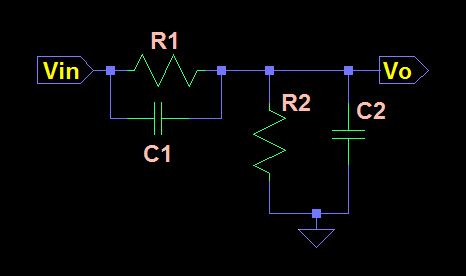
Intuitively Please : R1C1 Into R2C2
Intuitively, say what the bode plot should be. That part's not hard - you can work from what you'll get at f=0 and f=0 (what do caps do at both extremes?)
But, can you intuitively say what the pole and zero are? The math is easy, you could do this in a minute.. but.. think..
You already have a Thevenin circuit - so, if you make a Norton equivalent, what current do you get? And into what load? Get it - the load is everything in parallel - so, since that load looks like a short at infinite freq, obviously you have a pole at W = 1/(R1||R2 (C1 + C2)) . Easy.
Zero? What current do you get in your Norton equivalent? You have a part through an R and a C - at high frequency, it goes up because of the cap - so, obviously a pole - and, the frequency has to be W = 1/ (R1 C1). Childishly simple..
But, can you intuitively say what the pole and zero are? The math is easy, you could do this in a minute.. but.. think..
You already have a Thevenin circuit - so, if you make a Norton equivalent, what current do you get? And into what load? Get it - the load is everything in parallel - so, since that load looks like a short at infinite freq, obviously you have a pole at W = 1/(R1||R2 (C1 + C2)) . Easy.
Zero? What current do you get in your Norton equivalent? You have a part through an R and a C - at high frequency, it goes up because of the cap - so, obviously a pole - and, the frequency has to be W = 1/ (R1 C1). Childishly simple..
Wednesday, March 04, 2015
Digital Is Hard
Thought occurred to me today that what stands between me and being a successful subsystem designer (understand tradeoffs between the various topologies and control-schemes for power delivery) is a weakness with rapid digital prototyping..
It's easy to think of if-thens in your head. But how do you translate them into digital gates?
We're talking asynchronous stuff here - and not something neatly wrapped up in a box like a state-machine. Even an asynchronous one would be easy..
Subscribe to:
Posts (Atom)