Tuesday, March 25, 2025
How to Get Your Landing Page Right
 |
| The Meaning of Colors: How to Use Colors in Your Art — Serena Archetti |
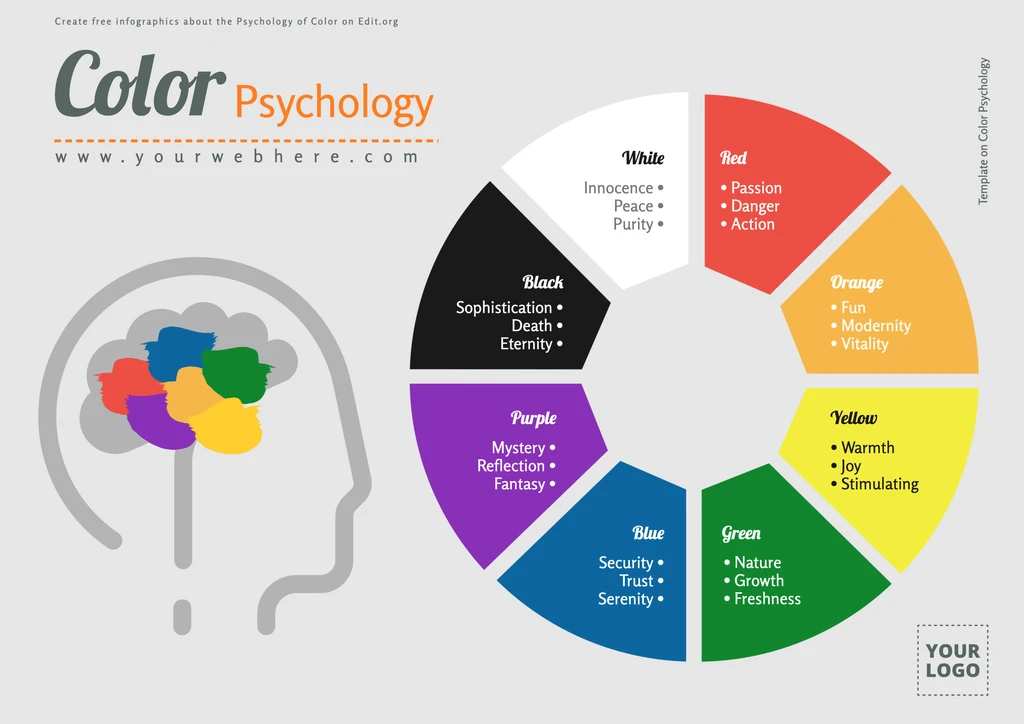 |
| Color Meanings in Marketing & Branding |
Everyone's heard of Google Analytics, but did you know about Microsoft Clarity?
| ✅ Do | ❌ Don’t |
|---|---|
| Use one clear CTA above the fold | Overload with multiple buttons or links |
| Design for fast scanning (use large headlines & bold colors) | Rely on dense paragraphs and tiny fonts |
| Apply high contrast for readability | Use low contrast colors that blend together |
| Guide the eye with visual hierarchy (F or Z layout) | Scatter important content randomly on the page |
| Use trust signals like testimonials and recognizable logos | Assume people will trust you just because your product is good |
| Build engagement gradually (micro-commitments) | Ask for too much info upfront (long forms) |
| Use simple, readable fonts like Arial or Roboto | Choose gimmicky or hard-to-read fonts |
| Tailor colors and language to your audience | Assume color psychology is universal |
| Optimize for fast load time (under 3 seconds) | Ignore performance—it’s just design, right? |
| Keep visitors focused (no popups or distractions) | Clutter the screen with irrelevant offers |
| Track behavior (clicks, scroll depth, conversions) | Guess what’s working and never measure anything |
| Test and update your page regularly | Launch it and forget about it |

Sunday, March 23, 2025
Prof. George Polya Shows You How to Solve It
You see, it is not a method. It is not a system. Teaching is not a science—it is an art. You cannot really put it into a system, but you may have an attitude toward it.
This attitude cannot be easily described in words—better in acts. I will try to show you that afterward, if I can. But for now, I can tell you a few slogans.
Let me put my first point in the form of a question and answer:
What is teaching?
In my opinion, teaching is giving students the opportunity to discover things for themselves. The teacher should not simply tell everything to the students. If they truly wish to learn, they must discover it on their own.
Second point: First guess, then prove.
All great discoveries were made in this way. The discoveries in the minds of Archimedes, Gauss, Newton—were conceived this way. Or at least, many important ones. And any kid in the classroom who finds something, finds it this way: first guess, then prove.
My third point is a direct application of this idea to mathematics.
Mathematics seems to consist entirely of proofs. But that’s not quite so. Finished mathematics consists of proofs—but mathematics in the making consists of guesses.
Introduction by Prof. R. A. Rosenbaum, Wesleyan University
The academic ideal in mathematics, as well as in other disciplines, is that of the scholar-teacher—the person who can contribute notably to the world store of knowledge and understanding, and who can also make others better through their teaching effectiveness. One man is acknowledged to be preeminent: the paradigm, the archetype and model for us all. This exemplar is George Pólya.
Much of Pólya’s academic life was spent in Switzerland after his education in Budapest. He came to the United States and joined the Stanford faculty in 1942. He holds a number of honorary degrees and has written many books and some 220 articles—most of them the fruits of his imaginative mathematical research. His contributions to the combined fields of mathematics and mathematics education are unequaled.
The demonstration you are about to see is truly unrehearsed and spontaneous. It illustrates his extraordinary, uncanny ability to stimulate a group to guess intelligently—to make reasonable conjectures, a process which is essential to mathematical discovery.
Prof. George Pólya:
Ladies and gentlemen, I don't wish to give you a lecture. I wish to teach you about guessing.
It's a very important part of life to be a good guesser, and a very important part of mathematics. You might wonder how—because mathematics is full of proofs, and only what is proven is valid in mathematics. So, where is the role of guessing?
Yes, mathematics, when it is finished and complete, consists of proofs. But when it is discovered, it always starts with a guess. I want to give you a real experience of this.
So instead of a lecture, we’ll play together a guessing game.
You should find out from your own experience what reasonable guessing is. Not wild guessing—anyone can do that. The less you know, the easier it is to make a wild guess. But educated, reasonable guessing—that’s something else. That should be learned, and a math class is a good place to learn it.
This game has two simple rules:
-
If you already know the answer to my question—please don’t answer. That would spoil the fun.
-
If you don’t know the answer—don’t hold back. Guess! Your guess may be wrong, but even a wrong guess helps lead to a better one, and eventually, to the truth.
Let’s begin.
The Problem:
I will give you a problem to guess.
It’s a problem of solid geometry. Not much to know there. For instance, what is a plane? A plane is very flat. The top of this desk, if it's well-made and smooth, approximates a mathematical plane. But the mathematical plane is ideal—flat and infinite in all directions.
Now imagine five such planes.
Imagine cutting a big block of cheese—Swiss cheese, green cheese, whatever you like—with five planes. One cut, two cuts, three, four, five. Each cut is a plane. These planes divide the space into several parts.
My question is: How many parts?
Who’s ready with a guess?
Student: 25?
Good! How did you get that?
Student: I did 5 × 5.
There’s an idea there. Great.
Anyone else?
Student: 32?
Oh! Interesting. You have something behind that.
Any more guesses?
Student: 10 spaces?
Okay, we’ll see who’s right.
But let’s pause. Guessing is just the beginning. Solving any real problem begins with a guess. A real problem always has some difficulty—otherwise, it wouldn't be a problem.
If you can’t solve it right away, what should you do? Wait for inspiration? No! The right thing is to imagine an easier problem to prepare you for the real one.
For example, I asked about five planes. Why not ask about fewer planes first?
So let’s go in order.
One plane:
Just one horizontal plane—like the surface of still water. It divides space into how many parts?
Student: Two.
Correct! Let's note that: one dividing plane → two parts.
Two planes:
Now imagine a second plane intersecting the first. You see two lines on the blackboard—those are intersections with the planes. Together, they divide space into how many parts?
Student: Four.
Right. Two planes → four parts.
Three planes:
Now, let’s imagine a third plane intersecting the other two.
Some parts are in front of the blackboard (the room), some behind. How many parts total?
Student: Eight.
Excellent.
Now let’s try a key idea in guessing: think of extreme cases.
What if there are zero dividing planes?
Then space is not divided—there’s just one region. So: zero planes → one part.
So far, we have this pattern:
-
0 planes → 1 part
-
1 plane → 2 parts
-
2 planes → 4 parts
-
3 planes → 8 parts
Now guess for four planes. Hands up!
Student: 16?
Who seconds that? Many of you? Good!
Yes, 16 is a reasonable guess. Why?
Because you observed the pattern: 1, 2, 4, 8… these are powers of 2. 2⁰, 2¹, 2², 2³.
You also had the courage to say: and so on. That’s an inductive generalization.
Is it proven?
Students: No.
Good. So let’s mark it with a question mark. It's a doubtful result—unproven.
Still, it’s a reasonable guess.
Now, how to test it?
Let’s actually try dividing space with four planes and count the resulting parts.
(He draws and demonstrates with tetrahedron.)
By analogy with dividing the plane by lines, if three lines in a plane create a triangle, four planes in space create a tetrahedron—a finite, enclosed solid.
We now count:
-
1 part: the interior of the tetrahedron
-
4 parts sharing a face
-
6 parts sharing an edge
-
4 parts sharing just a vertex
Add them: 1 + 4 + 6 + 4 = 15
But we guessed 16!
So what happened?
Answer: A very good guess—reasonable, inductive—but wrong. And that is the key experience.
Reasonable Guesses Can Be Wrong
That’s the lesson. A guess—even a respectable, inductive one—can be wrong. This is important in science and in life.
Now, let’s extend this analogy further.
We’ve looked at:
-
Space divided by planes
-
Planes divided by lines
-
Lines divided by points
Let’s take lines divided by points.
-
0 points → 1 segment
-
1 point → 2 segments
-
2 points → 3 segments
-
3 points → 4 segments
-
m points → m + 1 segments
So, we see a simple pattern here: number of parts = number of dividing elements + 1
Could we find a similar formula for space divided by planes?
This is an ambitious question—and it’s good to be ambitious in mathematics.
Return to the Original Question
So, if five planes divide space, how many parts result?
Look at our earlier numbers:
-
0 planes → 1
-
1 plane → 2
-
2 planes → 4
-
3 planes → 8
-
4 planes → 15
Now what about 5 planes? What number should come next?
Students offer guesses: 21, 26, 28, 29...
One student suggests 26 and explains:
"I saw a pattern. In the columns of a triangular number table, if you add two previous values, you get the next."
This is another inductive guess. Is it proved?
Students: No.
Right. But do you believe it more now, since 11 (in a 2D analogy) was verified?
Students: More.
That’s reasonable. The verification of 11 gives us inductive evidence for the pattern.
Final Thoughts
So 26 is not proven. But it has more credibility now.
The key points in reasonable guessing are:
-
Use extreme cases
-
Use analogy
-
Use induction
-
Test your guess
-
Always distinguish a fact from a guess
Let me close with a story about that distinction.
A member of the Royal Society in England once rushed into a meeting and gave his hat to the janitor without taking a ticket. After the meeting, the janitor handed it back to him.
The scientist said, a bit patronizingly, “How did you know it was my hat?”
The janitor replied sharply:
“Sir, I don’t know whether it’s your hat. It’s the hat you gave me.”
That’s the difference between a fact and a theory—a guess.
What You Can Do to Superage, not Just Age

|
Resource |
(Brad Dickerson) |
(Sari Harrar) |
(Lisa Feldman Barrett) |
(Amanda Maher) |
|
|
Active lifestyle |
X |
X |
X |
X |
X |
|
Self-imposed challenges |
X |
X |
X |
X |
|
|
Active social life |
X |
X |
X |
X |
|
|
Indulgence (treats) |
X |
||||
|
Anticipate frustration |
X |
X |
|||
|
Don't let age deter you |
X |
||||
|
Healthy diet (greens,
flavonoids, etc) to control BP and blood sugar |
X |
||||
|
More challenging
exercise than peers (quality, not quantity) |
X |
X |
|||
|
Avoid stress, prioritize
mental health |
X |
||||
|
Protect vision and
hearing |
X (cataract op + |
||||
|
Prioritize sleep |
X |
||||
|
More variety than just
sudoku/X-words. Shows, classes, etc |
X |
||||
|
Work hard at something
(difficult) (deliberate practice) |
X (swim, play bridge) |
||||
|
Resilience |
X |
Aren't you glad fasting ain't on the list? :) No mention of moderation either :) I guess they just took it for granted :) FYI, it's midcingulate cortex and anterior insula that evidence this superaging - "emotional" parts of the brain, not analytical ones. No wonder Einstein said he wished he had played more.
Thank you removepaywalls.com :) Couldn't have done it without you :)
Friday, March 21, 2025
chatGPT Kills Wolfram Alpha

Prompt : 43.489627631627631627631 (627631 repeating decimal) as P/Q
Wolfram Alpha : Wolfram|Alpha doesn't understand your query
To convert the number
43.489627631627631627631... (with 627631 repeating) into a fraction , let's follow the steps:
blah blah..
Final Answer:
This is the exact fraction representation of
43.489627631627631627631… where 627631 repeats.
What a class act. Move over Steve..

Wednesday, March 12, 2025
Why Do You Suppose Bing, but not Google Can Hack this Search?

Tuesday, February 11, 2025
Can You Recognize Emotions Given Just the Eyes? Try It
https://socialintelligence.labinthewild.org/mite
Your score is 28 out of 36.

Given descriptions of people, learn how good you are at finding optimal physical activities for them. Compare yourself to others! This study takes around 12 minutes. Try it!

Take this 10 minute test, find out and compare yourself to others. Try it!

What is your decision-making style? Take this 8-minute test to find out! Try it!


How well can you visualize objects in space? Find out and compare yourself to others.
The test typically takes 15 minutes. Try it!
Friday, February 07, 2025
Now That's a Gem - Productivity Hack - Lead Time Planning

I remember something similar in "How to Stop Worrying and Start Living" by D Carnegie - the laggards leave the office early to "go spend time with the family" whereas the go-getters plan the next day.
- There are no experts in business - they've just mastered the "act". There's a reason they pay these young smart consultants from McKinseay and Bain.
- The answers are usually hidden in plain sight. That is, the information is accessible. It takes so analysis to convert it into actionable insights.
- MBAs are a waste of money. This person did two years of history at Oxford and concluded : in a few weeks of formal study, you can learn enough about economics, finance and strategy. It helps to read about two dozen good books on strategy. (I guess speed reading comes naturally to someone who's doing a PhD in history at Oxford😊)
- No jerks. Ever. Would colleagues want to sit next to you on a long flight? (the "flight test"). Bascially : follow the no a$$hole rule!
- Everything's a grid. As in - important/urgent risk/reward pain/gain.
- The basics matter - agenda before meeting, lead time planning for next day, minutes and next-steps!
- Start at the end and go backwards. State the hypothesis and look for evidence the supports/contradicts.
- Don't look to consultants to save your company. They can only offer recommendations.
- Everyone is in sales - like it or not.
- Manage upwards - handy for the case that your company doesn't follow rule 4 😊 Example : DD works for "the Rottweiler" who works his team to death. Predecessors who burnt out focused on mastering work-work while DD mastered meta-work - in this case, he figured out the office phone-system so he figured out a way to let the Rottweiler's calls go to voicemail. He'd listen to the message at his leisure, do the bare minimum and then use the phone system to record a message to his boss to be delivered later - at 10:30 at night! The Rottweiler was actually telling DD that he was working too hard!
Sunday, February 02, 2025
If You're On Android, this is How Your Brain Works! Be Warned

From Michael Platt's excellent book: "The Leader's Brain"
Two years ago, Wharton neuroscience postdoctoral fellow Feng Sheng and I gathered groups of smartphone users to see if they had an emotional and social connection with their brand.
(they used fMRI to observe brain activity)
Apple users showed empathy for their own brand: The reward-related areas of the brain were activated by good news about Apple, and the pain and negative feeling parts of the brain were activated by bad news, they were neutral about any kind of Samsung news. This is exactly what we see when people empathize with other people—particularly their family and friends—but don't feel the joy and pain of people they don’t know.
Samsung users, on the other hand, showed no increased activity in either area when they were shown positive and negative news about their brand. Interestingly, though, the pain areas were activated by good news about Apple, and the reward areas were activated by bad news about the rival company — some serious schadenfreude, or “reverse empathy.”
If I were the Chief Marketing Officer of Samsung, I would be worried. Samsung customers' brains tell us they’re just not that socially and emotionally connected to the brand, and that makes the company much more vulnerable to a potential competitor (just as a weak workplace culture can lead to higher turnover).